Showing posts with label horror. Show all posts

Friday, December 10, 2010

Monday, November 8, 2010

Movies recently seen

Crumb (1994)

I first saw this documentary about underground comics legend Robert Crumb in 1996, with my then-girlfriend. It is not a date movie. Crumb's comics are notorious for their misogyny and racist imagery, while at the same time he is regularly acclaimed as a genius. Although his surname is a common word, a Google image search on the word "crumb" brings up nothing but images relating to his comics. This is despite the fact that he has never been published by any of the "major" comic book companies, and has actually self-published much of his own work. He is a strange-looking guy (skinny and gawky with coke-bottle glasses and deliberately old-fashioned clothes) who is apparently very shy, but on film he has a real charisma. He's a mess of contradictions, and this movie is a fascinating portrait of his work, his family, and himself.

The movie takes you through quite a but of his comics work, some of which is very disturbing, and gives equal time to his defenders and his critics. It's interesting that Crumb does not actually defend himself; he says that he made a decision many years ago to never censor himself and to let all the most disturbing images in his head come out onto paper, and that his creative process is largely unconscious and he doesn't know where his stories are going until he draws them. He says that sometimes he thinks perhaps he should not be allowed to draw this stuff and that maybe he should be locked up and have his pencils taken away from him, but at the same time it seems clear that drawing his comics is what keeps him on an even keel.

We don't learn too much about how Robert Crumb ended up the way he is, apart from some references to his father being a domineering and violent tyrant, but the interviews with his brothers and his mother make it pretty clear that Robert is the most well-adjusted member of his family, at least among those who appear in the movie (his two sisters declined to be interviewed).

This is a top-notch documentary that is best watched when you are not already feeling depressed.

Robert Crumb with two friends

Peeping Tom (1960)

Set in the sordid milieu of under-the-counter pornography, this movie is about Mark, a young photographer who is making his own snuff movies. It has some interesting parallels with the same year's Psycho, directed by the expatriate British director Alfred Hitchcock in America. The main difference is that while Psycho solidified Hitchcock's position as the master of thrillers, Peeping Tom caused director Michael Powell's reputation to plummet; he had been at the very top of his profession to this point, but was subsequently unable to make any more movies in Britain and ended up settling in Australia.

Melodramatic in the extreme and rather dated, Peeping Tom still has a curious power. Mark is very open to the idea of being caught, and manages to get caught between falling for a young woman in his apartment building and feeling driven to complete his "work". I found the comic relief scenes tiresome, but they actually drew big laughs from the audience I saw it with so that must be a matter of personal taste.

Moira Shearer gets it in the neck

The Abominable Dr. Phibes (1971)

Vincent Price stars as a crazed organist who is bringing the Ten Plagues of Egypt down on the surgeons he holds responsible for the death of his wife. He also talks through a gramophone horn connected by a tube to a hole in his neck. He has somehow convinced a beautiful silent woman to assist him in his murderous task.

As you can tell from the above plot description, this is the greatest movie ever made.

He calls her Vulnavia

Sunday, November 7, 2010

His Face All Red

I really want to push this wonderfully creepy short horror comic on to people. It's called His Face All Red and it's written & drawn by Emily Carroll.

Click on the picture below to read it.

Click here to read the story

I had not heard of Emily Carroll before, but after this I am very keen to read more by her.

Monday, November 1, 2010

Hallowe'en movies

I watched three movies on Hallowe'en.

Fellini Satyricon (1969)

Oh dear. This movie was very lavish. I'm sure it was also very artful. It certainly was bugfuck insane. It consistently kept me off-balance, did things I didn't expect, and everything about it was very inventive and bold.

So why was it so terribly dull?

It certainly looks striking

The story involves two students in ancient Rome who have picaresque adventures while fighting over the favours of a svelte young slave boy. These largely involve people going on & on & on at great length against extremely elaborate backgrounds and on extremely elaborate sets. It felt like an extremely wordy stage play that was barelay adapted to an extremely expensive movie, and then filmed by people who were very stoned.

As Michael pointed out, it felt a lot like an Alejandro Jodorowsky movie in terms of how completely weird it is. But for me, it had little of the intelelctual and spiritual charge of Jodorowsky's movies, and almost none of the interest.

I hope that Fellini's earlier movies turn out to be more interesting. This one was just self-indulgent wank. His fellow countryman Mario Bava, who worked in much more low-brow fields, was able to accomplish a lot more with a lot less many times. (And he seemed to know it; Fellini was a huge champion of Bava and was known to give his movies standing ovations - as well as the ultimate compliment of ripping him off; Fellini's Toby Dammit draws extensively from Bava's Kill Baby Kill.)

The Devil Rides Out (1968)

My favourite Hammer horror movie pits an imperious authoritarian figure (Christopher Lee) against a free-thinking mystic (Charles Gray). It feels like the establishment railing against some goddamned hippies, but I liked it anyway. Gray is superb as Mocata, the black magician inspired by Aleister Crowley (Dennis Wheately, who wrote the source novel, met Crowley once and seemed to take a lot of influence from him).

That guy really gets my goat

The best scene involves Mocata having a conversation with Marie Eaton (well played by Sarah Lawson) in which he methodically lulls her into submission and takes over her mind. If you watch the movie, pay attention to the editing of this scene; it's brilliantly put together.

Trick 'r Treat (2007)

Probably the best horror anthology movie I've ever seen, edging out the George Romero/Stephen King collaboration Creepshow (which it resembles in some ways), Trick 'r' Treat was a complete delight. It tells four stories that take place on the same Hallowe'en and in the same neighbourhood, which is being watched over by a creepy little urchin who seems to embody the spirit of Hallowe'en. The only cast members I recognised were Brian Cox (made up to resemble John Carpenter) and Anna Paquin (pre-True Blood). (I guess first-time director Michael Dougherty must have brought them over from X-Men 2, which he co-wrote.)

I am Sam. Sam I am.

All of the stories in Trick 'r' Treat were smarter than I expected, and the EC comics-style twists were perfectly realised. The Hallowe'en atmosphere was perfect, and the stories overlap in a fun way that reminded me of Pulp Fiction. More horror movies should be this well made and this much fun.

Maybe you'll see things my way before we get to Grandma's place...

Friday, October 29, 2010

It's nearly Hallowe'en...

I always get too excited about Hallowe'en. I'll share some of my excitement around now.

Here is an animated version of Edgar Allan Poe's short story The Tell-Tale Heart narrated by James Mason. I first saw this on the dvd of Hellboy, where it was in a section titled "Hellboy Recommends" along with some Gerald McBoing-Boing shorts.


Here is a clip of Ken Nordine, of Word Jazz fame, reading Poe's poem "The Conqueror Worm", taken from the great cd Closed on Account of Rabies. Nordine has the best voice imaginable for this poem.


My buddy David Schmidt wrote & directed the fascinating short film The Lovecraft Syndrome, inspired by the works of H.P. Lovecraft. Warning: this one is quite disturbing. It's available to view here on Spike.

Arch Oboler wrote & produced a classic episode of the old-time radio show Lights Out called "The Chicken Heart", rather absurdly about a chicken heart that eats the world. Years later, Bill Cosby did a terrific comedy routine about the effect it had on him as a small child.

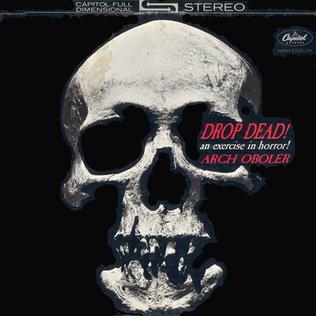
Here is the only version of "The Chicken Heart" I could find, much shorter and taken from Oboler's album Drop Dead: An Exercise in Fear.


Here is Cosby's routine, for some reason split into two parts:


Finally, here is one of the scariest things ever: "The Thing on the Fourble Board" from the old-time radio show Quiet, Please. Download the mp3 and then, late at night, on your own, turn out all the lights and settle down to listen to this one. It's old, it's dated.... but it's still scary.

Happy Hallowe'en, everyone!

I love Phantasm so much.

Tuesday, September 14, 2010

Movies seen recently

I've seen a few, at the movies and on DVD. Here are some of them.

Enter the Dragon

Bruce Lee's American movie is great fun, although the fight scenes are not as well-staged or well-filmed as the ones in his best complete movie Fist of Fury or in the the footage released from the incomplete original version of Game of Death. Enter the Dragon functions better as an American exploitation movie (poor Jim Kelly doesn't fare as well as he would have in a real blaxploitation movie though). John Saxon is miscast as a kung-fu expert; I would much rather have seen Rod taylor in his role.

But Bruce Lee's charisma saves the day, and although the ending is a straight copy of the superior ending of Orson Welles's The Lady from Shanghai it still works here.


Why John Saxon? Why? I mean, I like him, but WHY?!?

There Will Be Blood

A bona-fide masterpiece. Daniel Day Lewis is superb, and the movie earns its two and a half hour length. Worthy of an entire post, so it'll get one.

Oh yes.

The Haunted Palace

Roger Corman directs Vincent Price from a Charles Beaumont script based on H. P. Lovecraft's longest story, The Case of Charles Dexter Ward. It was shoehorned into the Corman/Price Edgar Allan Poe series with a retitling and some brief readings of Poe's titular poem. Great fun, and with the next one will be an entire future post.

The lovely Debra Paget's last movie

The Resurrected

Dan O'Bannon's early '90s adaptation of H. P. Lovecraft's longest story, The Case of Charles Dexter Ward, was mangled by its producers in post-production, leading to some obviously-truncated scenes and unnecessary voice-over. What remains takes a while to warm up, but emerges as a superior Lovecraft adaptation in its final act. Chris Sarandon actually tops Price as Charles Ward and, er, another character, and the two movies contrast in a fascinating way. A whole post will soon compare both movies with the original story.

Chris Sarandon's character is not actually insane

Robocop

An old favourite, this action-packed satire of the Reagan era is still hilarious. Superstar Dutch director Paul Verhoeven's best American movie; packed to the gills with great scenes.

Ronny Cox was brilliant in this

Piranha

John Sayles's first script is far from his best, but director Joe Dante and a great cast (including Kevin McCarthy - who just died aged 96, '60s Italian horror queen Barbara Steele, Sterling Hayden, Paul Bartel, and of course Dick Miller) make it all fun.

Kevin McCarthy, R.I.P.

Piranha 3D

Hilarious intentional-comedy makes great use of 3D effects, and even of Jerry O'Connell! Big, dumb, silly fun with a great in-joke cameo in the opening scene. Recommended to people who loved Gremlins and Mars Attacks.

Don't save him - he's Jerry O'Connell!

I'm sure there were more. I'll remember later. It was a good weekend.

Friday, August 6, 2010

Best horror movie titles for Friday

Horror movies seem to have the best titles, but Italian horror movies really take the cake. These are some of my favourites.

Your Vice is a Locked Door and Only I Have the Key


Forbidden Photos of a Lady Above Suspicion


The Iguana with the Tongue of Fire


Lizard in a Woman's Skin


All the Colours of the Dark


The Strange Vice of Mrs. Wardh


Don't Torture a Duckling


Strip Nude for your Killer


Twitch of the Death Nerve


What Are These Strange Drops of Blood Doing All Over Jennifer's Body?


Bonus: this one is not Italian, nor was it every made, and it probably would not have been a horror movie. But I really love that it made it to the poster stage.

Thursday, July 29, 2010

Amer (2009)

The best thing about this movie is its poster.

Pretty good, right?

Amer uses the iconography of the giallo in service of a non-narrative art movie. It is extremely technically adept. The first third of the movie is a near-perfect synthesis of visual & aural ideas from Dario Argento's Suspiria and the "Drop of Water" sequence from Mario Bava's I Tre volti della paura. This segment follows a young girl as she attempts to steal her dead grandfather's pocket watch, while hiding in fear from her grandmother (who is portrayed very much as Helena Marcos from Suspiria). There is palpable tension throughout, with a series of vividly creepy images fractured through interesting editing.

Very clearly influenced by Suspiria

Unfortunately I was far less entranced with the second third of the movie, depicting the same girl as a teenager. This third was closer to Stan Brakhage in its extreme visual deconstruction, but without his intellectual rigour. The whole movie seems built around linking sex and death, a theme that's taken from many gialli but which is not developed in an interesting way here: a girl sees her parents making love while she is already in a state of fear and for the rest of her life equates sex with violence.

Something about this girl reminds me of a Svankmajer heroine

The final third of the movie depicts the same character as an adult, and returns to the more threatening tone of the first part of the movie. This is the part where the sexualisation of violence reaches its apex, and my interest was once again piqued. The movie comes full circle at this point: where the first segment features sex depicted as violence and death, the end features violence and death depicted as sex.

More Argento influence

It's just a shame that it was all so empty. If there was more to hang the movie on, or perhaps if the movie was half its present length, the impressive visual and aural techniques (the soundtrack inventively reuses giallo themes by Ennio Morricone, Bruno Nicolai and Stelvio Cipriani) wouldn't seem so much like a formalised experiment. The juxtaposition of sex and death is such a constant in the giallo (and in film in general) that just serving it up once again isn't enough on its own.

This probably sounds like a complete pan, but I actually quite enjoyed Amer. It absolutely nails the aesthetics of a good giallo, and it's a genre I have a lot of affinity for. I have absolutely no problem with style over substance, and I'm a fan of non-narrative film. I loved the homages to many individual movies throughout Amer - not just gialli but also things ranging from Un Chien Andalou to Jan Svankmajer's Down to the Cellar.

Amer is a feast for the senses, deeply sensual and arousing. I guess I'm a little confused by it - I'm tempted to go again to the Sunday session.

Sex and death are very interesting, don't you think?

Monday, July 26, 2010

The Guardian (1990)

Here we have a movie in which a dull American couple with a new baby hires an English nanny, which turns out to be a bad idea. Not just because, as the audience knows from a pre-credits sequence, this particular nanny has a penchant for sacrificing babies to a tree; but because their first reaction to having a child is to turn its care over to a complete stranger immediately.

At least the nanny loves her tree.

The movie actually opens with a disclaimer telling us that not all trees are evil. At first I thought this might be an in-joke, referring to the disclaimer before co-writer/director William Friedkin's earlier movie Cruising which started with a disclaimer stating that not all homosexuals are extreme S&M fetishist serial killers, but by the time the movie finished I was convinced that it was earnestly meant. This is an earnestly stupid movie.

Friedkin has made some terrific movies including The French Connection, To Live and Die in L.A. and (most relevant here) The Exorcist. The Guardian has no good dialogue, no good acting, weak cinematography, terrible music (by Jack Hues from '80s band Wang Chung) and a terrible story full of plot holes. Friedkin has said that the movie is an attempt to create a modern-day version of a Grimm's fairy tale, but it fails miserably in this respect as well. Even the gore scenes are dull.

The movie was originally by Stephen Volk (who also wrote the insane Ken Russell-directed Gothic, the silly but fun Joanna Pacula vehicle The Kiss, and Ghostwatch) and this is the worst movie I've seen from him. As his script was rewritten by Friedkin, I'm reluctant to pass any of the blame on to Volk.

The story involves a woman who is either a Druid or a tree-spirit (the movie seems a bit confused about this) who has to sacrifice babies to a malevolent tree for reasons that are unclear. The babies need to be less than 20 days old, or else their "baby genes" will have turned into "normal genes" and presumably the tree won't want them anymore.

In one of the more memorable scenes, she is hanging with the baby in the woods when three cartoonish rapists appear seemingly out of nowhere and threaten her with a big knife. She lures them to the tree, which then kills them in gruesome fashion. They are impaled, eaten (yes by a tree) and spontaneously combust. Later she goes back to the tree so it can heal the rather nasty stab wound she received during the fracas; it's unclear as to why she needs to leave and come back to do this, except that it allows an uninteresting minor character to follow her and see what she's up to, so that she can send her magic wolves to eat him.

I'm unsure why a tree spirit can command magic wolves, unless it's just to add to the supposed fairy-tale ambiance that the director needed to explicitly point out before I noticed that it was there.

There is a rather stupid scene where the father takes the baby and runs off into the woods while the nanny flies after him and the mother drives alongside in the family four-wheel drive. (Finally explaining why wealthy city & suburb dwellers drive those sorts of vehicles - I guess the fear of tree-worshipping nannies is more prevalent than I had assumed.) It concludes with her driving her car full-force into the nanny, who slams into the tree and seemingly dies. The parents are then furious when the cop on the case (played by the irritating husband from Candyman don't take their story seriously.

The finale of the movie involves the mother fighting the nanny for the baby while the father goes at the tree with a chainsaw. When the father cuts off a tree limb, the nanny's leg falls off. That was the best part of the entire movie - an unintentional laugh.

This movie, in case I have not been clear enough, is quite aggressively bad. It is not so-bad-it's-good, nor is there a case for critical appraisal. I fell asleep the first time I tried to watch it.

Also, what the hell is up with evil trees in horror movies? I've already written about Poltergeist but off the top of my head I can also think of The Woods, Evil Dead & Evil Dead 2 and From Hell It Came, and I'm sure there's plenty more.

If you want a good Grimm's fairy tale for adults movie, see A Company of Wolves (directed by Neil Jordan, based on stories from The Bloody Chamber by Angela Carter).

Can't be bothered with screen shots for this one

Monday, July 19, 2010

Blacula (1972)

Our movie opens in Transylvania, 1780. Prince Mamuwalde (William Marshall) and his wife Luva (Vonetta McGee) are the guests of Count Dracula (Charles Macaulay). Over dinner, they attempt to convince the Count to join their mission to abolish the slave trade. As well as being an undead fiend who feasts on the blood of the living, Dracula turns out to be a racist. After taking time out to mock and insult Manuwalde and Luva, he bites Mamuwalde, turns him into a vampire, locks him into a stone coffin, and seals up Luva in the same chamber to die...

Blacula sleeps

In the early 1970s American movie studios woke up to the fact that although they had a long history of exploiting black people, and an equally long history of exploiting audiences, it had never really occurred to them to exploit black people as an audience. Writer/producer/composer/director/star Melvin van Peebles showed the way with his independent movie Sweet Sweetback's Baadasssss Song, which made a huge amount of money for him and co-financier Bill Cosby. MGM "legitimized" the trend with Shaft, an even bigger hit with the added bonus of a smash-hit award-winning soundtrack album. Suddenly every producer in town wanted a movie about a cool black dude who beats up honkies to a hot funk beat.

In an always-racially charged country going through a particularly stressful time, a prominent black cinema could have offered a chance for expression. As is so often the case with a new trend, the first wave of movies out the gate were exploitative and often unpolished. Many of these movies were consciously made with mostly black crews, who had been locked out of the unions until very shortly beforehand. Because of this there was a dearth of experienced black talent. The first wave of blaxploitation movies (as they came to be known) offered a training ground for a new black cinema.

There should have been a renaissance of black-led cinema at this point, but an unfortunate series of events prevented this. The first was simply that audiences tired of the movies becoming too formulaic. At first the mere depiction of the black experience onscreen was considered to be a revelation; a number of people have written about how it felt to see Richard Roundtree being unable to hail a cab at the start of Shaft because nobody would stop for a black man. Black leads had been incredibly rare until then (just look at how everybody still points at Night of the Living Dead, from 1968, as being a real marvel because its lead role just happened to be played by a black man - the idea that a character could be written without any regard to race and then cast as black was completely unheard of before this). There was an element of overcompensation to many of these heroes: Sweet Sweetback floored many people just because the hero actually survived past the end of the movie, but later movies would feature leads who were effectively superheroes. But when people eventually tired of this specific portrayal of black characters in movies, producers interpreted it as meaning that audiences were tired of black-oriented movies.

Another factor was from pressure groups (particularly the NAACP, the Urban League and the Southern Christian Leadership Conference, who joined forces to form the Coalition Against Blaxploitation) who were dissatisfied with the portrayal of black people in blaxploitation movies. They did have a point, as a number of the most prominent movies featured pimps and drug dealers as heroes, although this was not true across the board. But this controversy, combined with audience drop-off and the (mostly white) producers' failure of imagination, lead to the cycle being shut down pretty quickly. No new attempts to reach a black audience were made, except by a handful of (mostly black) independents, and the cliché of "the black character dies first" picked up where it left off. The next wave of black filmmaking didn't really take hold for over ten years, with actors like Eddie Murphy and directors like Spike Lee breaking into the studio system on their own terms.

All of which is, I think, much more interesting than the movie currently under discussion, but let's get back to that anyway.

After a fun animated opening credits sequence involving a bat chasing a woman (see the YouTube video at the bottom of this review), we cut to 1972 where two gay-stereotype interior decorators have bought the entire contents of Dracula's castle, including Mamuwalde's coffin. When they break it open,he promptly bites them and escapes. Before long he runs into Tina (McGee again) and realises that she is the reincarnation of Luva.

Blacula gets some

Mamuwalde divides his evenings between romancing Tina (who doesn't need much convincing about the reincarnation idea, and who is remarkably calm upon learning that her beau is a vampire) and biting more people. He wants to turn Tina into a vampire so the two of them can be together forever, but he only wants her to come willingly. As played by William Marshall, a very tall actor with a Shakespearean background, Mamuwalde is an old-school gentleman with impeccable manners, charm and style. Though he is slightly out of place in 1972 (as one guy keeps saying, "That is one straaange dude!") he seems to adapt to the modern world with no difficulty at all.

The modern world

He also has no problem with killing white cops who would shoot an unarmed black person in the back. This is really the only way in which he is a typical blaxploitation character.

Mamuwalde's nemesis is Dr. Gordon Thomas, a forensic scientist working with the police who was a friend of one of the interior decorators. Dr. Thomas is another atypical character for the genre - he's not a criminal and he's not precisely a cop. He's also highly educated, intuitive, and figures out that Mamuwalde is a vampire who's killing people very quickly. Unlike many vampire hunters in movies he doesn't run off at the mouth about his theories and get judged as a nutcase, but gathers actual incontrovertible evidence that he can present to his white cop buddy to gain the support of the police force.

Inevitably, things do not go well for Mamuwalde and Tina/Luva. After she is shot in the back by a white cop while unarmed and running away, Mamuwalde is compelled to bite her in order to save her life. Unfortunately she is swiftly staked by Dr. Thomas's white cop buddy. All the fight goes out of Mamuwalde at this point, as he considered her to be the only thing worth living for. He goes up onto the roof, exposing himself to the sun, and melts away to a skeleton in a nicely disgusting worm-eaten finale.

The death of Blacula

Blacula was the first blaxploitation movie to move away from the action genre. It takes a similar idea to the same year's Dracula AD 1972 in bringing the story of Dracula (if not the character, in this instance) into a contemporary setting. The Hammer movie was a lot more polished, but Blacula is more in touch with its time; where Hammer made a movie that was so self-consciously modernised that it instantly became a period piece, Blacula is just a movie that's typical of its milieu.

I'm spending a lot of time avoiding the point here: Blacula is a bad movie. It's one of those movies where you can see the blocking. The cinematography is borderline inept, and there's no atmosphere to the movie at all. The acting ranges from competent to dreadful, with Marshall the one notable exception. The music (by Gene Page) is far from the best that the genre has to offer, though the musical interludes in the club are fun. The script is terrible, as is the pacing. None of this stops the movie from being perfectly entertaining, especially if you're a fan of cheesy low-budget horror movies or blaxploitation.

Lead actress Vonetta McGee sadly died ten days ago, so I'm not pleased to report that she is the worst actor in the movie. She looks lovely, but she's completely wooden. William Marshall, on the other hand, is terrific as Mamuwalde. Marshall has a deep and very theatrical voice, and is completely convincing as an essentially good-hearted aristocrat who loathes what he has been turned into. He is commanding and dignified, though his dignity is slightly dented by the silly vampire makeup he wears in a few scenes.

This is a movie that the Coalition Against Blaxploitation would probably have had little problem with. None of the characters are pimps, drug dealers or criminals. The villain, though black, is portrayed with dignity and his villainy stems from being infected with vampirism by a white racist. The hero, also black, is a forensic scientist whose white cop buddy is deferential towards him. It also features strong anti-racist rhetoric, though mostly in the pre-credits sequence.

If you want to see a cheesy horror movie packed with early '70s decor, fashion and music, Blacula should fit the bill nicely. If you want a good movie, best to keep moving.

As for the Dracula factor, the appearance of Dracula himself is not inconsistent with the novel or with other portrayals. As the pre-credits sequence is set a hundred years before Bram Stoker's novel, the idea of Dracula as an internationally-known dignitary is not completely unreasonable. His treatment of Mamuwalde is reminiscent of the legend about Vlad Tepes (Dracula's main inspiration) where, when foreign ambassadors refused to remove their hats for cultural reasons, he ordered them nailed to their heads. And given the nationalistic fervour he has in the novel, it's not at all surprising that he's hideously racist.

Dracula: Prince of Racists

The theme of a vampire encountering a reincarnation of his lost love centuries later was later used in two Dracula movies I know of, the 1973 tv movie written by Richard Matheson and starring Jack Palance, and the 1992 movie directed by Francis Ford Coppola and starring Gary Oldman. I'm sure that it must have appeared earlier than in Blacula but nothing immediately comes to mind.

I'm planning to watch the sequel Scream, Blacula, Scream soon, but I'm unsure as to whether it actually counts as a Dracula movie. Given that Dracula himself appears in this first movie (but presumably not in the second) and that Blacula is a racist epithet bestowed on him rather than his name, I'm reluctant to view Mamuwalde as a Dracul substitute. He's far too distinct a character in his own right anyway. But what do other people think?

This is the trailer, showing most of the 'best' scenes:


This is the fun opening credits sequence, featuring Gene Page's theme music:


Rar!

Friday, July 2, 2010

The Legend of the 7 Golden Vampires (1974)

In 1804, the evil warlord Kah (Shan Chan, Intimate Confessions of a Chinese Courtesan, Five Fingers of Death tracks down Dracula's tomb and asks him to revive the 7 Golden Vampires under his command. Dracula (John Forbes Robertson) mocks his request and decides instead to kill Kah, assume his form and head to China to command the 7 Golden Vampire for himself.

I am going to use way too many pictures this time, I'm sure.

He starts like this...

...and switches to this.

One hundred years later, Professor Van Helsing arrives in China to learn about Chinese vampires. Addressing the Professors of Chongqing University, he tells a story about a small village which is under the thrall of the 7 Golden Vampires. This story is played out as almost a self-contained horror story, as a farmer discovers that his daughter has been kidnapped by Kah (presumably actually Dracula) along with a number of other young women, and charges in to save them. Both the farmer and his daughter are killed, but not before he manages to kill one of the 7 Golden Vampires, who are accompanied by a huge horde of other vampires that have risen from the grave to do Kah/Dracula's bidding. Some of these vampires can be seen to hop, following the tradition of the Chinese hopping vampire that was later used in Sammo Hung's Mr. Vampire series.
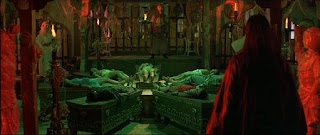
Kah/Dracula indulges himself

The dead walk

Anyway, the response of the learned audience is to say something along the lines of "You stupid European peasants might fall for such superstitious bullshit, but here in China we have a civilisation going back thousands of years, so please credit us with some intelligence," as they all walk out on him.

Later he is approached by a man who had attended the lecture, Hsi Ching (David Chiang, The Water Margin, New One-Armed Swordsman), who claims to be from the village Van Helsing had spoken of and asks for his assistance in killing the 7 Golden Vampires. Finance is put up by a rich widow, Vanessa Buren (Norwegian model Julie Ege, Up Pompeii, Rentadick) and the team set out accompanied by Hsi's sister and six brothers, all kung fu experts. Van Helsing's son Leyland tags along as well.
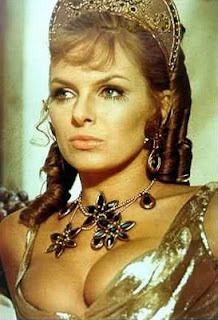
Julie Ege really couldn't act. I wonder why she kept getting cast in movies?

The rest of the movie basically follows this troupe as they make their way to the village, getting into kung fu fights with bandits and later with vampires, until they finally reach the cursed village and get to fight the 7 Golden Vampires. There are a couple of surprises along the way.

First of all, I expected the character of Vanessa to be a love interest for Leyland Van Helsing, and indeed at first he does seem to be courting her, but he is soon put off by her independent ways. ("They'll be wanting the vote next!") Leyland finds himself much more taken with Mai Kwen (Shih Szu), who despite being a kick-ass kung fu fighter is portrayed in non-fighting scenes as being submissive (as was typical of Western portrayals of Asian woman who weren't actively evil). So far so boringly normal.

So submissive

Much more interesting is that Vanessa turns out to be the love interest of Hsi Ching. This is very unusual indeed. Asian men are usually denied any kind of sexuality in Western movies - even today - unless it is to ridicule them. (Think of Long Dong Duk in Sixteen Candles.) To pair David Chiang with Julie Ege would have been positively revolutionary at the time. Unfortunately it doesn't quite pay off - one of these couples lives and one of them dies, and you get exactly one guess as to which is which. However the death scene is a real doozy: Vanessa has been bitten by a vampire and turned, and goes on to bite Hsi; his response, realising that he will also turn, is to impale them both together on the same stake.
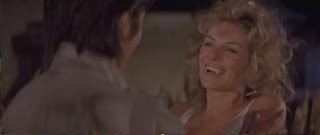
'When you think about it, it's actually a form of intercourse - but not for everyone.' - Tom Waits

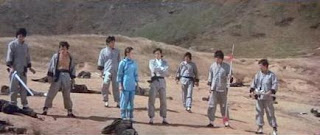
Another surprise is that the kung fu fighting is actually pretty good. I knew that the movie was packed to the gills with stars of Shaw Brothers movies, as this is a co-production between Hammer and Shaw, but I expected that Roy Ward Baker's typically stodgy direction would get in the way. From what I've since read (in the book Roy Ward Baker by Geoff Mayer) Baker wanted to direct all the kung fu fighting himself, but after producer Run Run Shaw viewed the rushes from his first attempt, he insisted on bringing in Chang Cheh to handle these scenes with a second unit.

One brother

Two brothers


Seven brothers and their one sister

Chang Cheh is one of the absolute masters of martial arts cinema. For a point of reference, John Woo considers him to be his mentor. He directed such movies as The One-Armed Swordsman, Five Deadly Venoms, Golden Swallow, and (my favourite) the epic The Water Margin. Cheh used his favourite choreographer Lau Kar-Leung (who went on to direct such classics as 36 Chambers of Shaolin, 8-Diagram Pole Fighter and the Jackie Chan movie Drunken Master II) and many of his regular stars and stuntpeople. I wouldn't say that Legend of the 7 Golden Vampires represents anything like their best work, but it's respectable, and the movie never gets TOO dragged down in scenes of the Van Helsings holding their own against obviously-superior opponents.

Cheh was the director most responsible for bringing explicit bloodshed to the Chinese/Hong Kong martial arts movie, so it's good to see plenty of the red stuff being splashed around here. Shaw Brothers blood actually resembles Hammer blood quite closely, so there's a definite link in styles there, even if Cheh's fluid direction clashes somewhat with Baker's more static mise-en-scène.
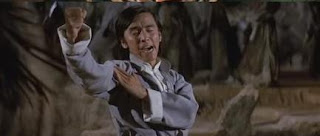
David Chiang does his thing

The sexual element of vampirism is far less pronounced than in Hammer's previous Dracula movies. The reason for this is simply that Dracula himself is even more of a background figure than usual (sadly we are spared any scenes of a kung fu Dracula) and the 7 Golden Vampires all appear as desiccated corpses, with no obvious sex appeal and no apparent sex drive. However, Baker confirms his reputation as Hammer's most exploitation-minded director in several scenes of topless Chinese women being tortured by Kah/Dracula and the 7 Golden Vampires.

These two vampires just had their Twilight fan fiction slammed by Robert Pattinson.

The end of the movie is a little anticlimactic. After a huge final battle, in which all of the seven brothers and the 6 remaining Golden Vampires are all killed, Van Helsing faces off with Kah and convinces him to resume his original form as Dracula before easily staking him. The End!

Peter Cushing does his thing

John Forbes Robertson is, erm, not good as Dracula. He's wearing silly theatrical makeup (reminiscent of that worn by Howard Vernon in Jess Franco's Dracula Prisoner of Frankenstein) and is dubbed by someone else. I'm not surprised that Christopher Lee refused this one, but it's a damned shame they didn't cast someone who could fight, act, or at least look the part.
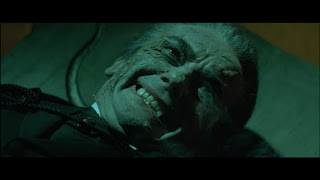
Van Helsing, you bitch! You ruined my makeup!

Cushing is fine as Van Helsing, even though the character should be dead. Hammer continuity is often poor, but this really pushes it. In Dracula AD 1972, Van Helsing is shown to die in 1872; this movie is set in 1904 and he's still moving about quite a bit. I thought that perhaps he might be Lawrence Van Helsing Jr., but reference is made in the movie to him being the one who had fought Dracula, which kills that theory.
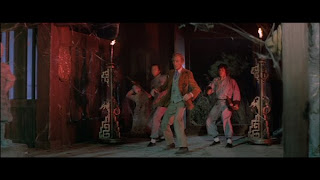
Just to prove that Van Helsing and the Seven Brothers actually shared some screen time

(Speaking of Van Helsing descendants: if Leyland actually stays with Mai Kwen, then I guess this means that Lorimer and Jessica Van Helsing are part Chinese. Hammer never did follow Bram Stoker's line about Dracula being a corrupting foreign influence, so it's great to see them actively promoting miscegenation in this movie - even to the point of letting non-white men get with white women, which is still somewhat taboo.)

Yeah I'm going a bit crazy on the pictures today. I couldn't resist. This movie was really fun. You should watch it.

A bigger continuity problem comes from Dracula himself, who takes on the form of Kah in 1804, heads to China, and is still there in 1904. Even if we presume that none of the previous movies actually happened, there are multiple references to his previous fights with Van Helsing. Was Dracula a dual citizen throughout the 19th Century, dividing his time between China and Europe and changing his appearance constantly? I guess it's possible, but it seems more likely that scriptwriter Don Houghton (who also wrote Dracula AD 1972 and The Satanic Rites of Dracula) just didn't think about it ever hard. Or possibly didn't think about anything ever, or even comprehend the meaning of the verb "think". Amazing to think that this guy had already written some pretty decent Doctor Who stories and went on to write a good one for Sapphire & Steel. Maybe he was in the middle of a massive drug binge when he was working for Hammer. Maybe he just didn't give a damn. He died 19 years ago (to the day as it turns out - I feel a little bad talking shit about him now) so we'll probably never know.

At least we were spared another of those awful ITV soundtracks! James Bernard's score is apparently mostly pieced together from pieces of his earlier ones, and I'm still not a huge fan, but it's a vast improvement over what we had to put up in the previous two movies. As is the rest of the movie - except, of course, for Dracula.

The American poster - for this version they apparently cut out 20 minutes and repeated scenes of violence & nudity to boost the running time. Apparently it ended up incomprehensible and repetitive - who would have guessed?

Here ends my Hammer Dracula marathon. Hammer would only produce one more horror movie after this, the dreadful Dennis Wheatley adaptation To the Devil... A Daughter, as well as a handful of movies based on British sitcoms and a remake of Hitchcock's The Lady Vanishes. It's a shame that they didn't get to continue putting Dracula into more modern and exotic genre movies. It would have been cool to see them get together with Toho to try and revive two dying franchises at once with Dracula vs. Godzilla.

The best image I could find of this type

Next week, a short-lived movie series that was much more successful at bringing the Count into the 1970s.

(Well, more commercially successful anyway. And it's not really Count Dracula himself, though he does make a cameo appearance at the start of the first movie. It also features much better music.)

Ladies and gentlemen, next week I bring you... Blacula!